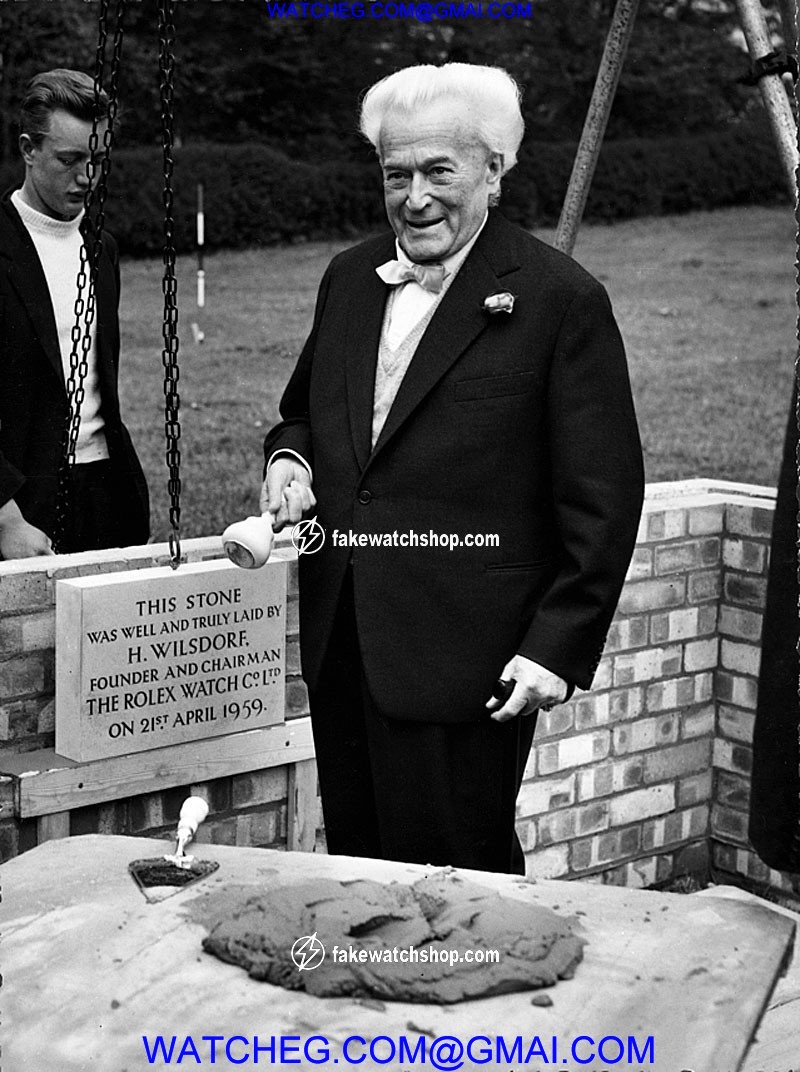
Welcome back to A Brief History Of Time. Today, we present the second installment in our multi-part series on the history of Rolex. If you missed Part One, you can check it out here.When we left off in 1945, Rolex had just celebrated its 40th anniversary. It had marked the occasion with the introduction of the Datejust, the first automatic watch with a date window. The now-famous Jubilee bracelet had also made its debut on that very model, and Rolexs post-war recovery was off to a great start. Whether founder Hans Wilsdorf had any idea just how important the next 15 years would be for the company is up to speculation. Nevertheless, these years would mark not only a series of impressive technological advancements but also the debut of some of the companys most sought-after watches to this day.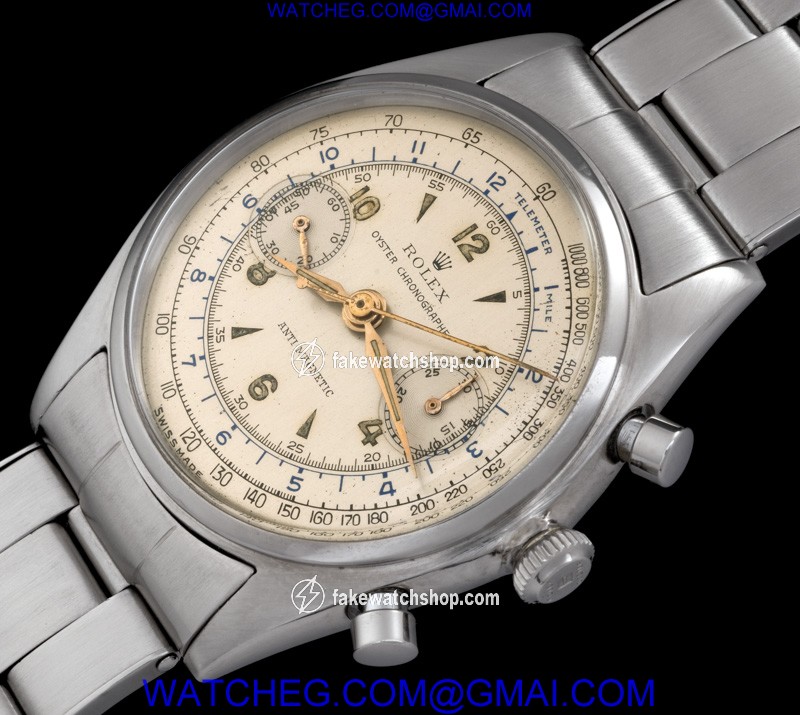 Rolex ref. 4500. Image credit: Rolexpassionmarket.comRolexs first Oyster chronographAround 1945, Rolex introduced its first waterproof Oyster chronograph, reference 4500. This 36mm anti-magnetic watch featured a very similar case to the Datejust, but without a fluted bezel. Instead, the smooth bezel appeared one with the case itself. With its monoblock appearance, modern-day enthusiasts nicknamed this model the Monoblocco. It came in steel, yellow gold, pink gold, and two-tone combinations. The most common variants featured silver or white dials with contrasting gold indices, though black and salmon dials were also options. The dial displayed both an inner telemeter scale and an outer tachymeter scale, a running seconds sub-dial at nine oclock, and a 30-minute chronograph totalizer at three oclock. At the heart of the timepiece was the Valjoux 23 movement. It would still be many years before Rolex would attempt to make its own chronograph caliber.
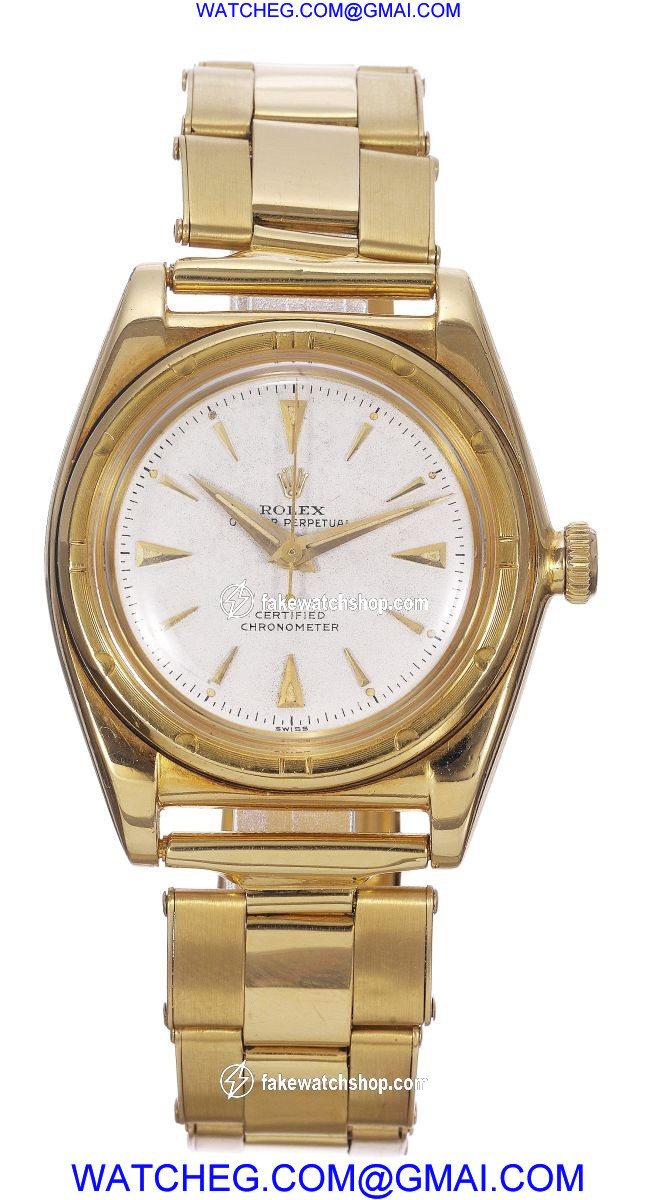 Rolexs 50,000th officially certified chronometer. Image credit: AntiquorumPost-warIn 1945, Rolex produced its 50,000th certified Swiss chronometer. Wilsdorf sought to give this benchmark timepiece to a worthy, heroic recipient. His choice was General Henri Guisan, commander-in-chief of the Swiss army during World War II. Wary of a Nazi invasion, Guisan had strengthened the most vulnerable areas of the Swiss border. He had also devised an elaborate defense plan for the retreat of the Swiss government into a hidden fortress in the Swiss Alps. Though Switzerland managed to maintain its neutrality, had German forces invaded, Guisans plan would have allowed the government to sustain itself in hiding for as long as necessary. Under his protection, Guisan swore that the Nazis would never conquer Switzerland. And he was right. Ever thankful to Guisan for protecting the country of his livelihood, Wilsdorf gladly presented him with the 32mm 18k yellow gold Oyster Perpetual.
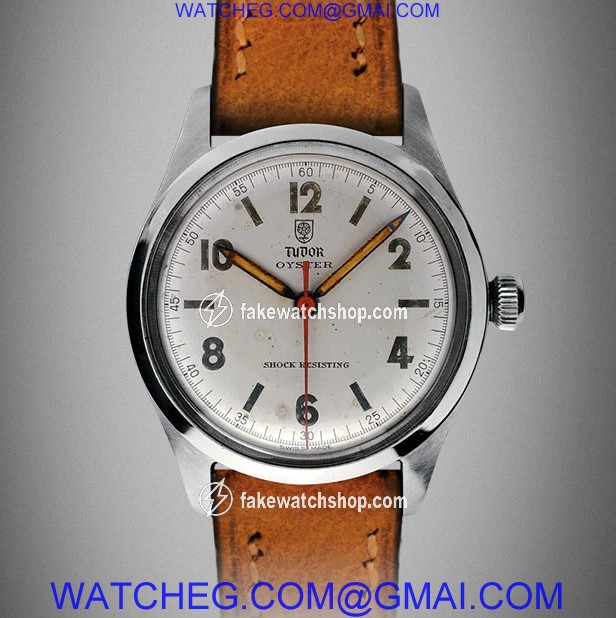 Tudor reference 4463The official founding of TudorIn 1946, Hans Wilsdorf officially registered Montres Tudor SA. Though Wilsdorf had, in fact, produced Tudor watches in some capacity for the Australian market since the early 1930s. After the war, however, he felt it was time to properly establish the company. On March 6, 1946, Wilsdorf stated,For some years now I have been considering the idea of making a watch that our agents could sell at more modest prices than our Rolex watches, and yet one that could attain the standards of dependability for which Rolex is famous. I decided to form a separate company, with the object of making and marketing this new watch. It is called the Tudor Watch Company.In 1947, Tudor produced its first water-resistant model. This Tudor Oyster, reference 4463, ran on the 15-jewel manually wound Fontainemelon caliber FHF 30-1 (Tudor caliber 59). The watch featured a 34mm steel case and a plethora of dial and hand options. In the coming years, Tudor would ramp up advertising, taking off in earnest in the 1950s. But well save further details for Tudors very own Brief History Of Time articles in the future!Rolex on the wrists of men who matterIn 1947, just three years after Rolex produced its 50,000th chronometer, the brand produced its 100,000th. To mark the occasion, Wilsdorf again sought to give it to someone of great historical importance. This time, he set his sights on Sir Winston Churchill, former Prime Minister of the UK, whose leadership during World War II had inspired millions. Wilsdorf sent Churchill a letter requesting the honor of gifting him a Datejust of his choosing. You can read Churchills enthusiastic response below.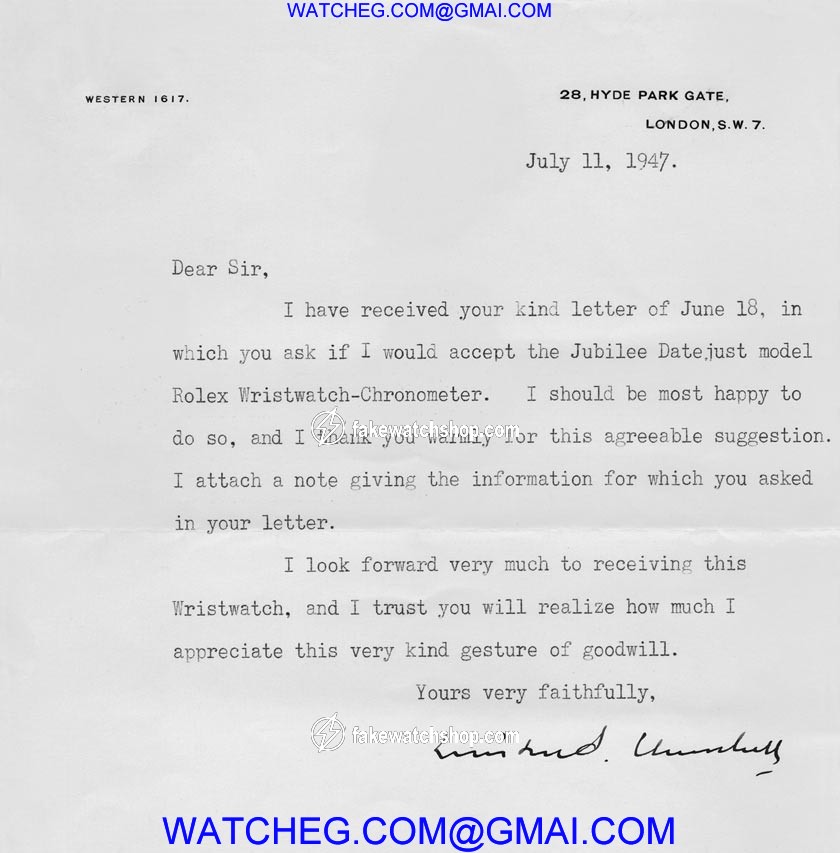
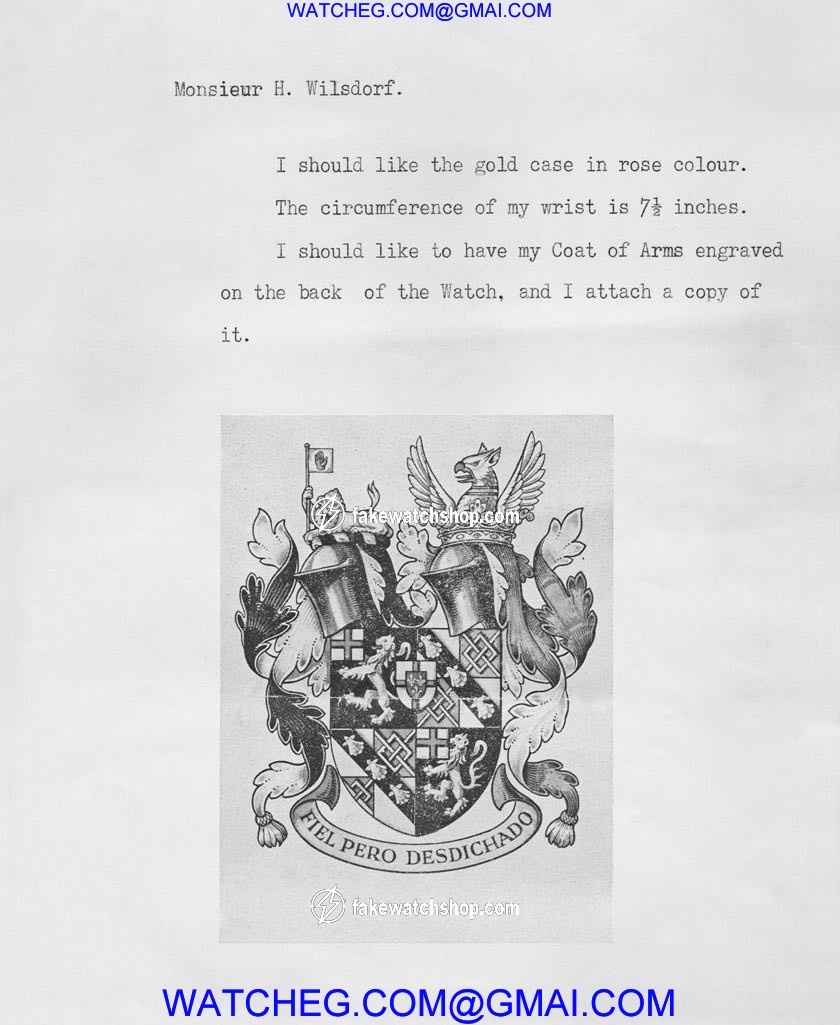 Of course, Wilsdorf was happy to oblige Churchills request, and Rolex produced the Datejust below.
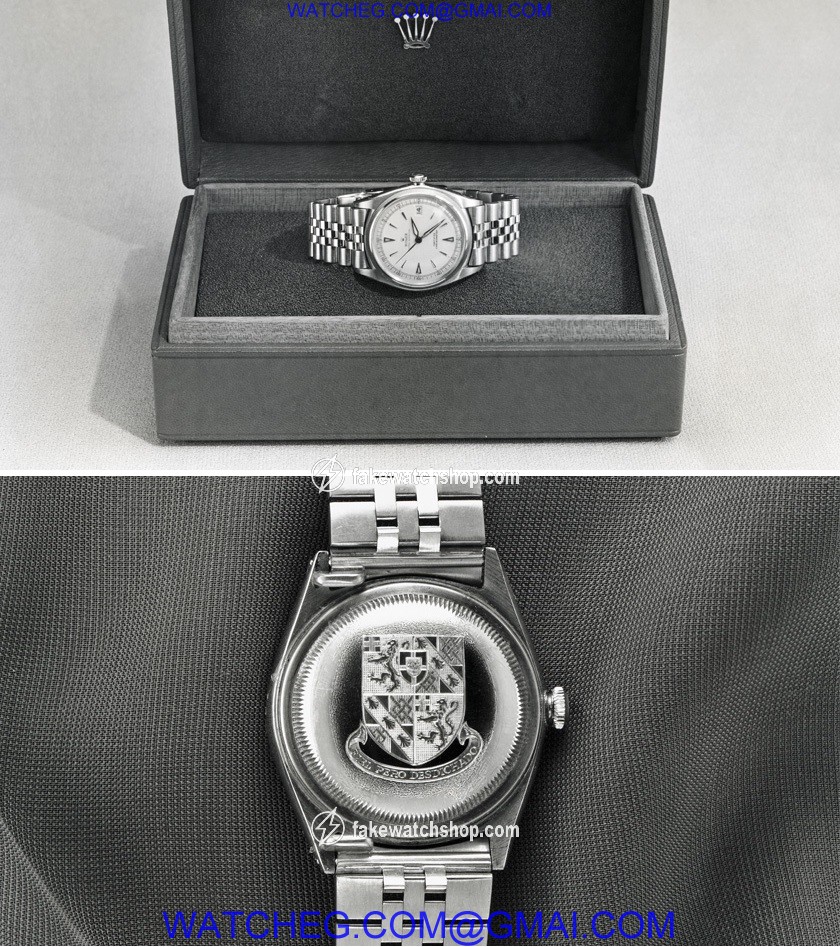 The sincerity with which Wilsdorf offered this gift is noteworthy. While Rolex advertising is rife with brilliant and, some might say, opportunistic associations to historical figures, Wilsdorf never once mentioned this gift to Churchill in any Rolex marketing. Perhaps he knew that a story of this magnitude didnt need to be told by him at all. In time, the story would tell itself, building the brands legend organically.
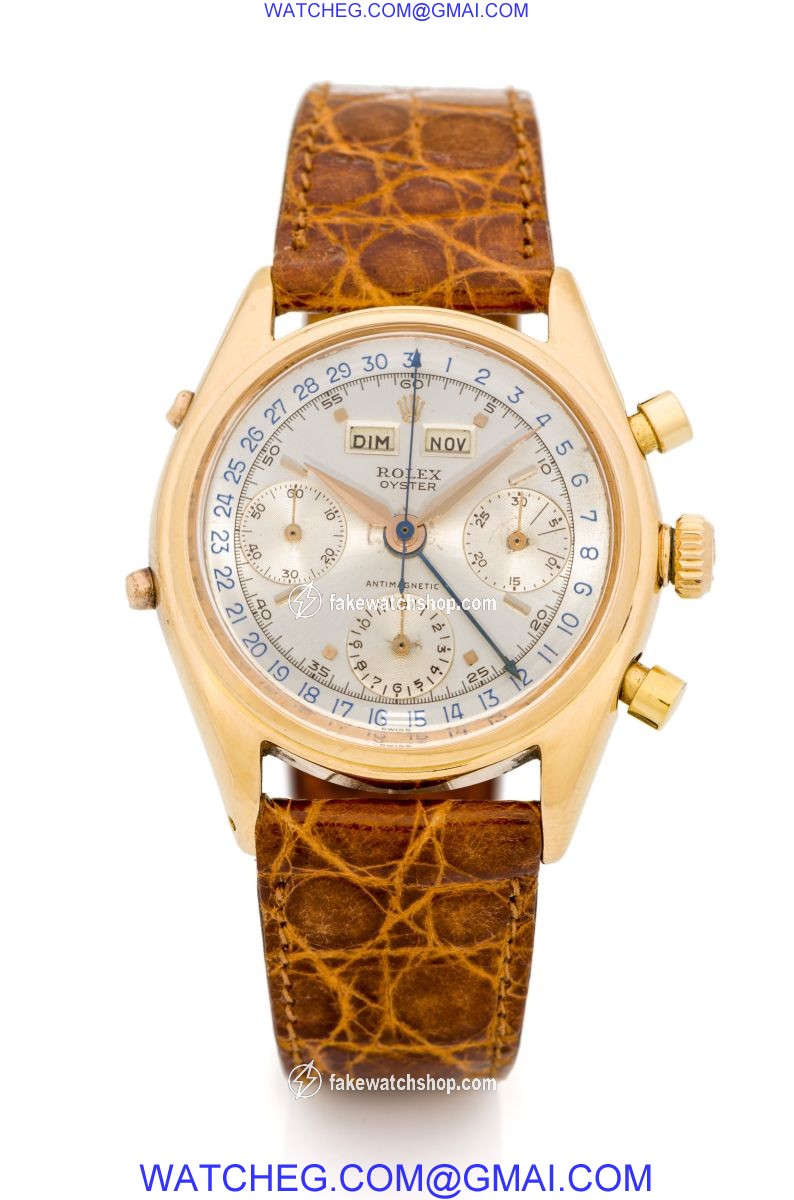 Rolex Dato-Compax reference 4767. Image credit: AntiquorumOnward, upward, and fast-forwardRolex produced its first triple-register Oyster chronograph in 1947. The Rolex Dato-Compax reference 4767 was the brands first chronograph with a 12-hour totalizer. Equipped with the Valjoux caliber 72C, the watch also featured a triple calendar with blue pointer date indications on the perimeter of the dial and day/month apertures between 11 and one oclock. The 36mm case came in steel, yellow gold, and rose gold. Years later, enthusiasts would nickname this watch the Jean-Claude Killey, after the famous French skier who reportedly wore one.
 Image credit: Latimes.comThe same year, a Rolex also graced the wrist of the first human to officially surpass the speed of sound. On October 14th, 1947, United States Air Force officer Chuck Yeager flew the experimental Bell X-1 Glamorous Glennis aircraft at an altitude of 13,000 meters (43,000 feet), breaking the sound barrier and reaching Mach 1.06 at 1,127km per hour (700mph). On his wrist during the flight was Yeagers very own Rolex Oyster (reference unknown) which he had bought during his service in World War II. Yeager would go on to become a lifelong Rolex wearer and proud brand ambassador.The grails of the future
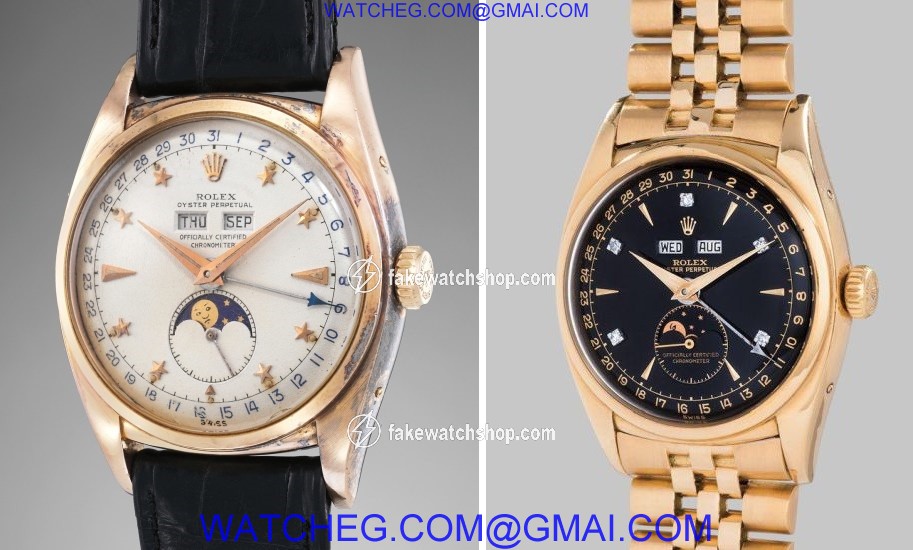 Rolex reference 6062 Stelline (left) and Bao Dai (right). Image credit: PhillipsIn 1950, Rolex also introduced the worlds first automatic watch with a triple calendar and moonphase in a water-resistant case. The 36mm Oyster reference 6062 was the second of only three Rolex references to this day to feature a moonphase complication (the others being the prior, non-water-resistant reference 8171 Padellone and the current Cellini Moonphase). Powered by caliber 655, Rolex produced reference 6062 for only a few years in yellow gold, rose gold, and steel. One of the most beloved traits of this reference is the star-shaped indices on some of the dials. Only three examples with black dials and diamond indices exist. The Bao Dai above is the only one of these with diamond indices for even hours. The watch belonged to Bao Dai, the last emperor of Vietnam. In 2017, it sold at auction for an astounding $5,060,427.Another 50,000 chronometers in the booksIn 1951 Rolex produced its 150,000th chronometer. Continuing the pattern of honoring the great heroes of World War II, this time, Rolex wanted to give the watch to Dwight D. Eisenhower. The five-star American General, Supreme Allied Commander of the Allied Expeditionary Force, and the architect of Operation Overlord (D-Day) was responsible for some of the most important Allied victories of the war. On December 19th, 1950, he also became NATOs first Supreme Allied Commander of Europe. As the brand had done with Churchill, Rolex sent a letter to Eisenhower asking if he would accept the gift, to which Eisenhower gratefully agreed.
 Eisenhowers Rolex Datejust (with service replacement dial and crystal). Image credit: Americanheritage1.comRolex presented him with the 36mm 18k yellow gold Datejust reference 6305. Engraved on its case back were the five-star general insignia, initials D.D.E., and the date of Eisenhowers appointment as NATOs Supreme Commander. The Jubilee bracelet clasp also featured the engraved initials D.D.E.
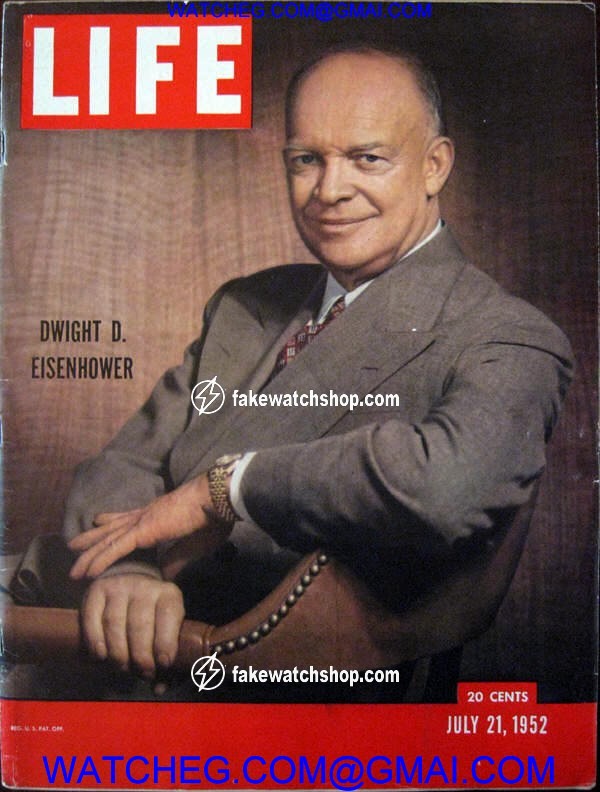 Though it was unknown at the time, in 1952, Eisenhower would go on to be elected the next President of the United States. Throughout his presidency, his Datejust would be a nearly constant companion. Indeed Eisenhower would wear it for some of his most visible moments for the rest of his life. This included his photo for the July 21, 1952 cover of Life magazine, in which the unmistakable Jubilee bracelet featured prominently. As with General Guisan and Churchill, Rolex never mentioned this gift in any of its advertising.
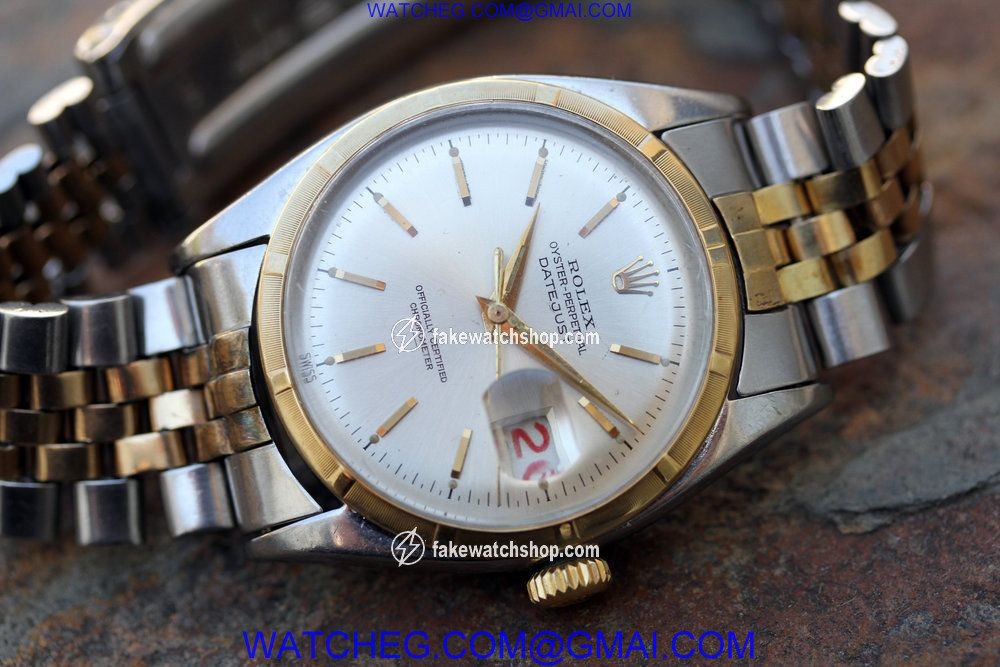 1953 Datejust reference 6304 with Cyclops lens. Image credit: Lunaroyster.comRolex carves out its future image1953 was a year of brand-defining developments for Rolex. The first among these was the debut of Cyclops date magnifier. As the story goes, Hans Wilsdorfs second wife, Betty Wilsdorf-Mettler, had a hard time reading the date on the Datejust. Wilsdorf pondered over a solution to this problem until one morning, inspiration struck. While washing his hands, a drop of water landed just so on the crystal of Wilsdorfs Datejust. Noticing how it magnified the date, Wilsdorf excitedly headed off to work, where he had a watchmaker glue a small lens on top of the crystal. It worked, and the solution stuck. When Rolex brought the idea to market on the Datejust that year, the Cyclops lens and crystal were manufactured as one single piece of plexiglass. Wilsdorf, extremely protective of this innovation, threatened legal action against anyone who dared to copy it.
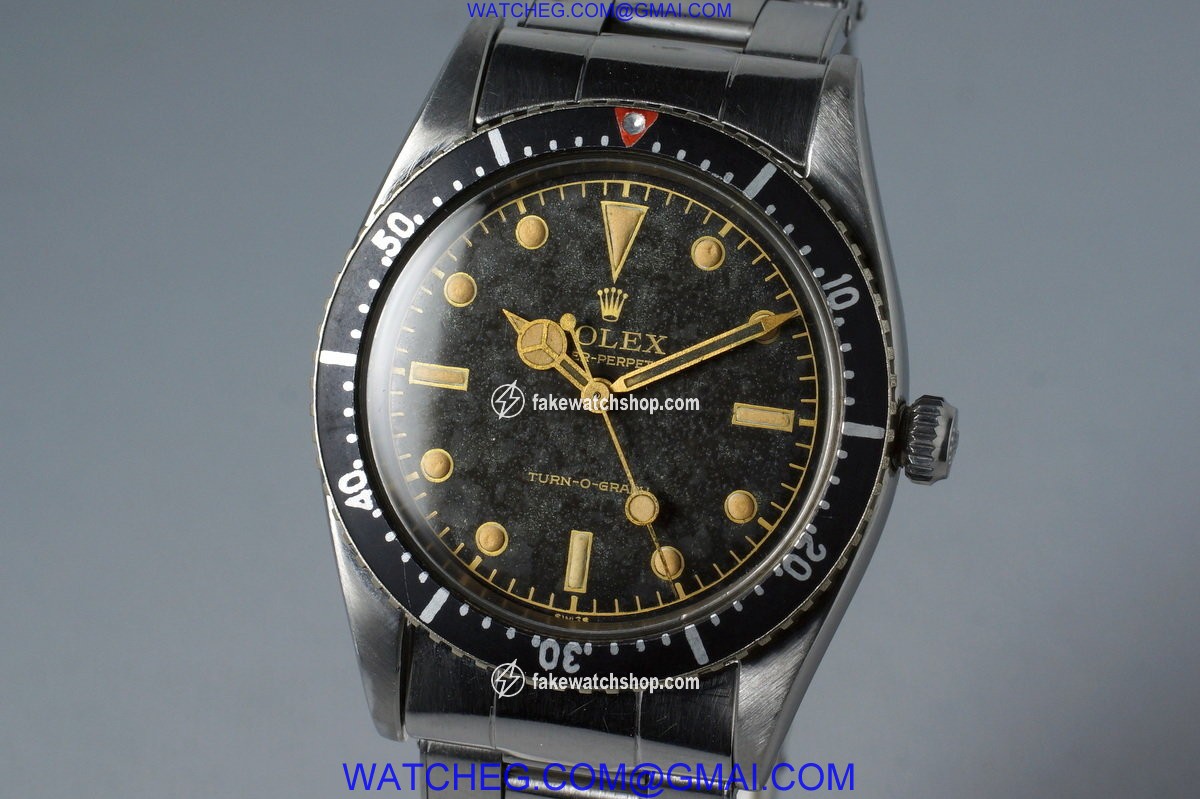 Rolex Turn-o-Graph reference 6202. Image credit: Hqmilton.comThe second major development of the year was the Turn-o-Graph, reference 6202. The watch was the very first mass-production Rolex to feature a rotatable bezel. The 36mm stainless steel watch featured an Oyster case water-resistant to 50m, a black aluminum bezel insert with a red triangle at 12 oclock, a black dial with gilt printing, and luminescent hands and indices in a style that Rolex uses to this very day. Most examples of these watches appear on a riveted Oyster bracelet. Starting in the 1950s, the Oyster bracelet would become the go-to choice for Rolexs hardiest tool watches. This Turn-o-Graph was the true precursor to perhaps the brands most famous watch of all time, the Submariner.
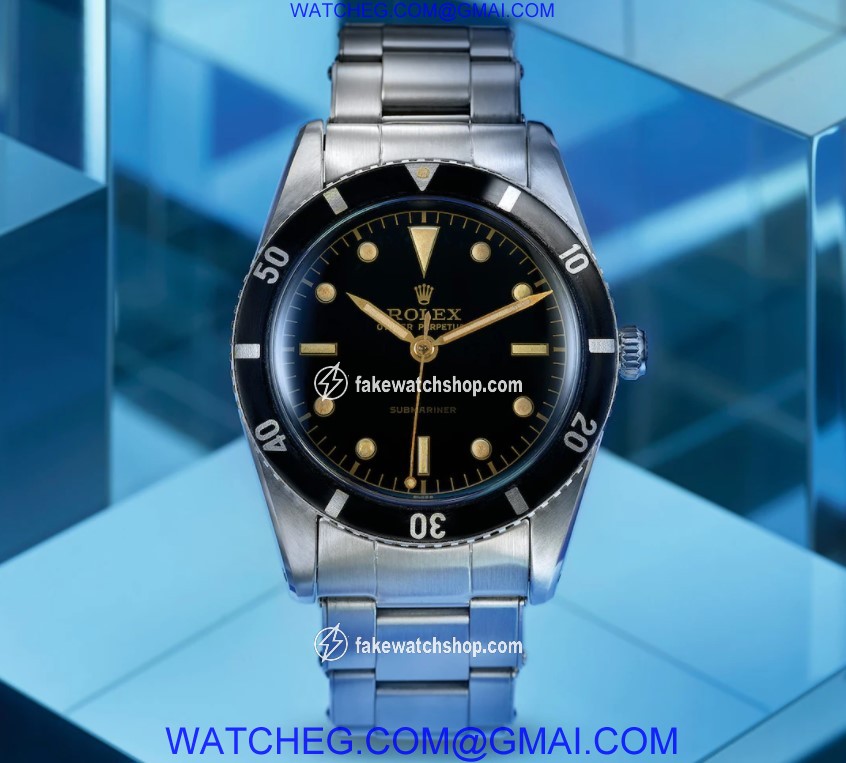 Rolex Submariner reference 6204An icon is bornIn fact, the now-legendary Submariner was not far behind. Brand director Ren-Paul Jeanneret, himself a diving enthusiast, teamed up with diving legend Jacques Cousteau to convince Wilsdorf that a professional diving watch would be a worthy addition to the catalog. The watch would not only be technically capable but also elegant enough to wear every day. In 1953, Rolex completed the development of the first Submariner, reference 6204. Though the brand would not debut the watch to the public until the Basel Watch Fair in 1954, the Submariner was already being put through its paces by the time it was released. Slightly larger than the Turn-o-Graph at 37mm, the Submariner featured double the water resistance, for a total of 100m. Though Blancpain had introduced the 91m water-resistant Fifty Fathoms a few months earlier, the Submariner was even more capable.Differentiating itself from the Turn-o-Graph, the Submariner 6204 featured not only a slightly larger case but also pencil hands and a silver triangle on the bezel. These differences, however, were perhaps not enough to justify having both models in the catalog. Thus, the Turn-o-Graph 6202 was only produced for a year or two, and its design was relegated to the more water-resistant Submariner. A significantly different Turn-o-Graph would re-emerge as a Datejust with an engine-turned 60-minute bezel later in the decade. The Submariners design, however, would persist. During its first few decades in the catalog, the Submariner underwent rapid development in its specs. While it is impossible to cover all these changes in detail in this article, I will highlight the most significant changes as we progress.
 Rolex Deep Sea Special. Image credit: Rolexmagazine.comDiving to new depths1953 was also a year for extreme accomplishments. Pushing the limits of its water-resistant technology, Rolex aimed to make a watch that was water-resistant to at least 6,000m. After several failed attempts, the engineers at Rolex finally found a design that worked. The 42.7mm watch was called the Deep Sea Special, and it featured a massively domed crystal and Rolexs standard caliber 1000. Shortly before father-and-son team Auguste and Jacques Piccard attempted to break the world depth record in Castellamare, Italy in September that year, a Rolex staff member personally handed them the Deep Sea Special.
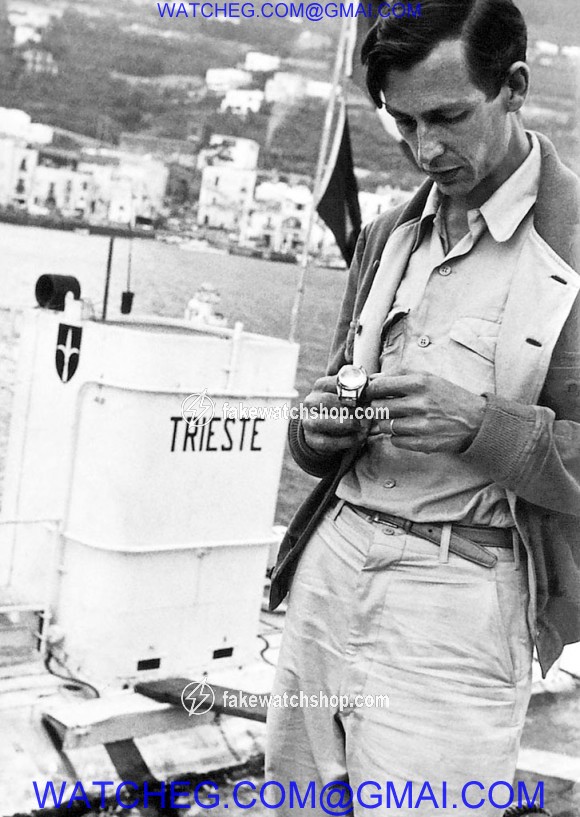 Jacques Piccard with the Deep Sea Special. Image credit: Rolexpassionreport.comThe Piccards attached it to the outside of their bathyscaphe Trieste and descended to a depth of 3,150m. Despite an over two-hour submersion, the watch remained completely unbreached by water. Shortly after returning to the surface, the Piccards sent a telegram to Rolex in Geneva. It read:Watch Performed Perfectly Depth 3150 Metres Piccard.The Piccards had set the new world depth record, and the Rolex Deep Sea Special had been right there with them when it happened. As we will find out later, however, this accomplishment was not the end of Rolexs quest for the ultimate in water-resistant timepieces.
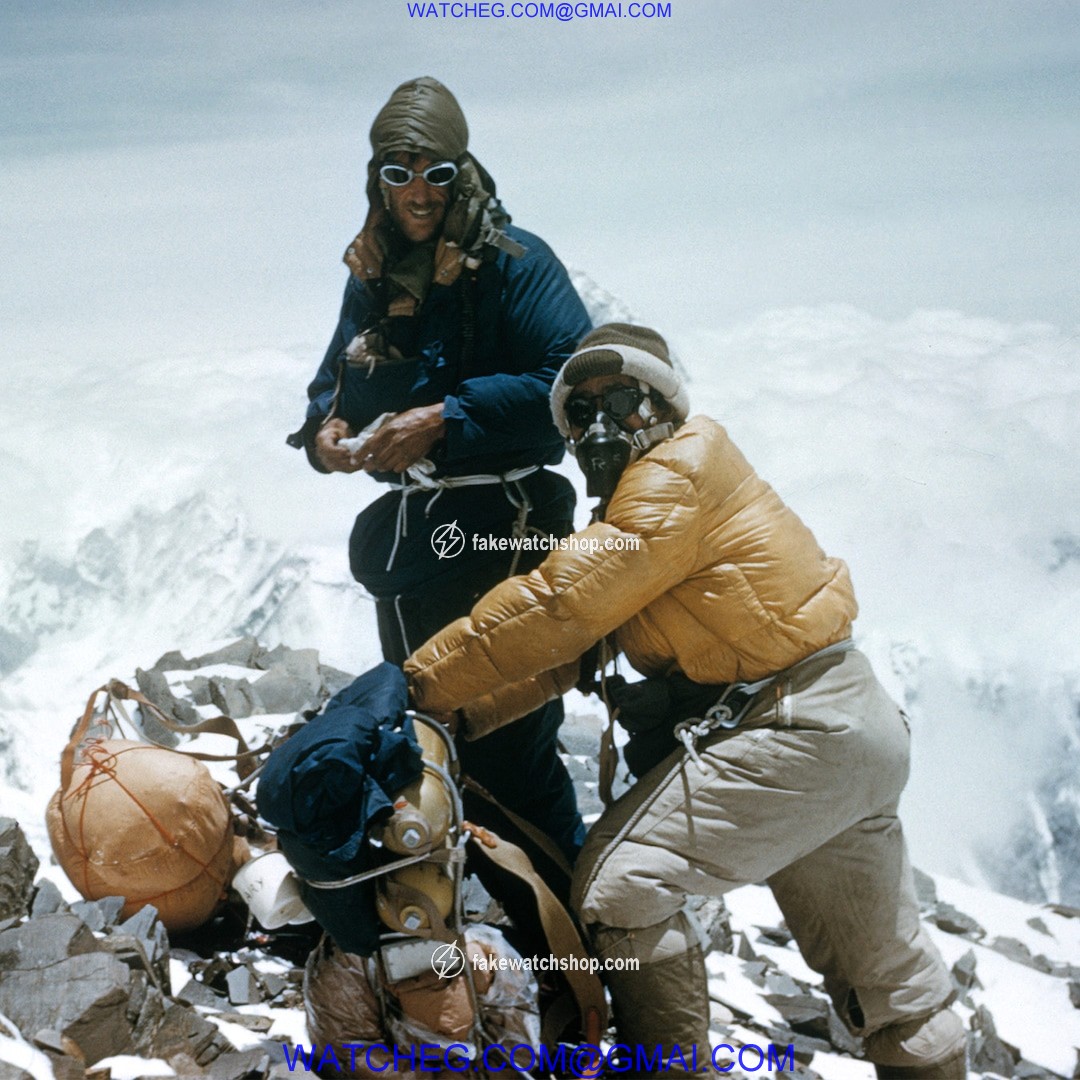 Sir Edmund Hillary and Tenzing Norgay on Mount EverestReaching new heights supposedly?Supporting the quest to go to extremes, Rolex equipped all members of John Hunts 1953 Mount Everest Expedition team with Oyster Perpetuals. When two members of the team, Sir Edmund Hillary and Tenzing Norgay became the first humans to ever reach the summit on May 29, Rolex assumed that those Oyster Perpetuals had been on their wrists. The brand published the following advertisement in The Times of London.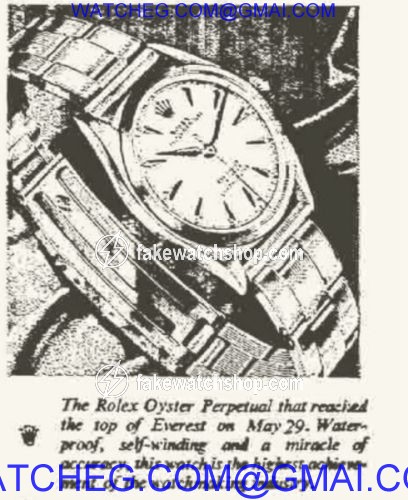
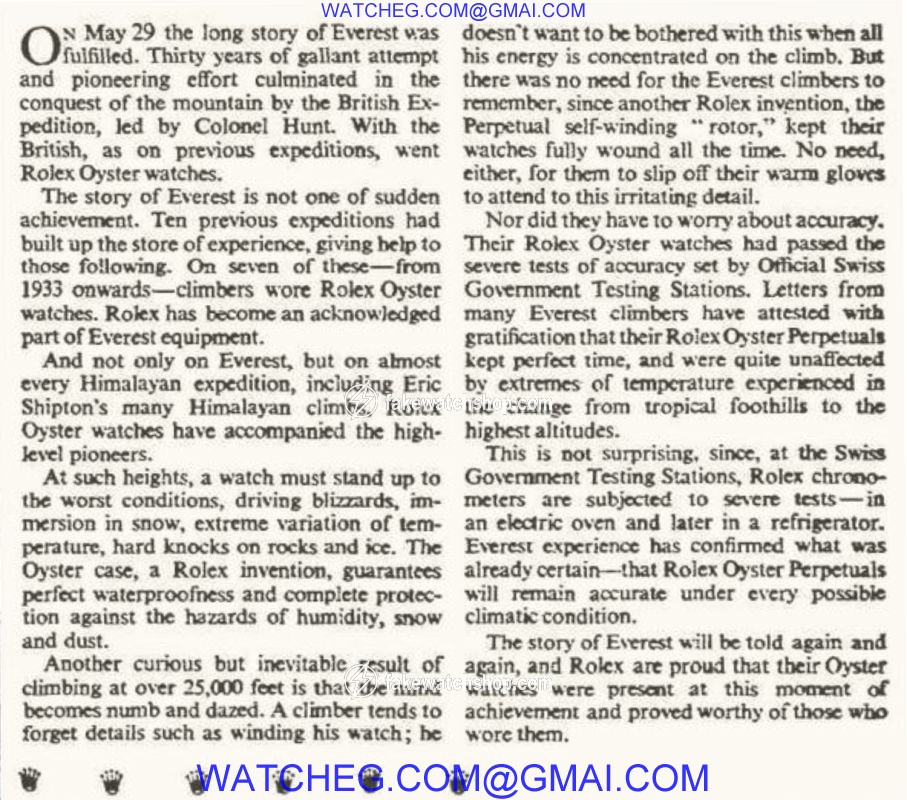 Though Hillary would go on to become a staunch Rolex ambassador after the expedition, he himself admitted in writing that it was indeed not a Rolex, but a Smiths De Luxe watch that accompanied him to the summit. He even offered the watch to the Clockmakers Museum at the Science Museum of London for permanent display. While it has been suggested, however, that Tenzing Norgay may have worn a gold Rolex Datejust that he received from Rolex one year prior to reaching the summit, I personally believe that the jury is still out on the hard facts. The most in-depth analysis of the evidence that Ive seen to date can be found here, should you wish to dig deeper. What is clear, however, is that Rolex has backed off of making claims about their watches on the summit of Everest. Today, the brand simply states on its website that the members of the expedition were equipped with Oyster Perpetuals.
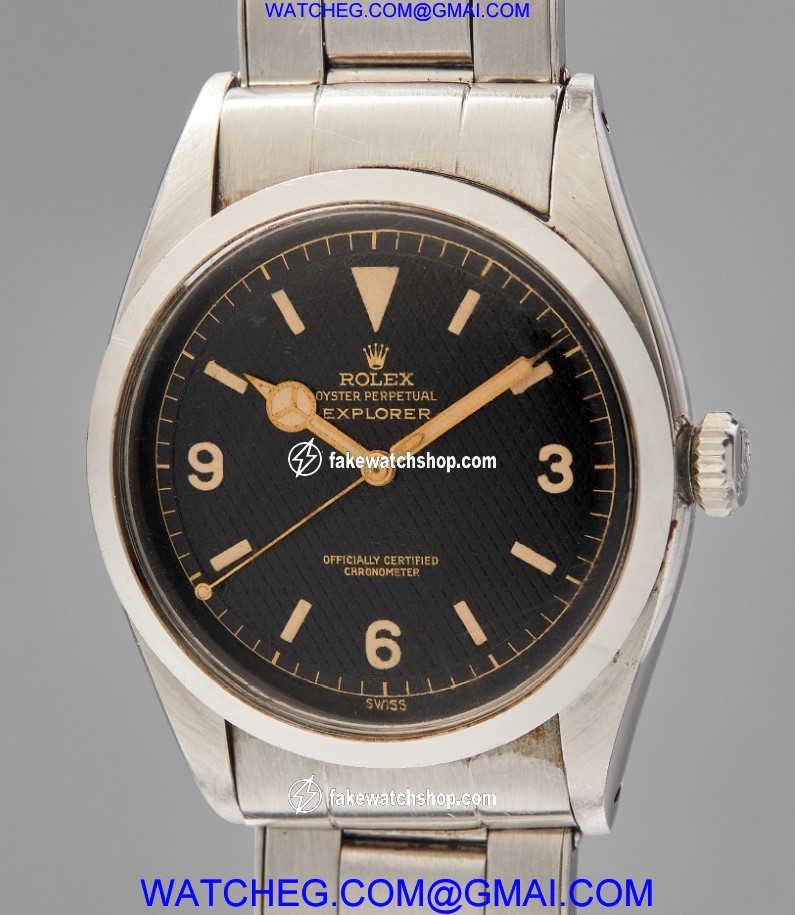 Rolex Explorer reference 6350. Image credit: PhillipsThe Explorer is bornWhether a Rolex watch actually reached the summit of Mount Everest in 1953 remains a mystery. Nevertheless, the brand released the Explorer later that year. Quickly following the Pre-Explorer reference 6150, reference 6350 was the first to actually feature Explorer on the dial. It was inspired by the adventurous spirit of those who undertook the climb and featured a specially strengthened 36mm stainless steel case. Powered by the Rolex A296 chronometer-certified automatic caliber, it was equipped with special lubricants, making it resistant to temperatures from -20? to +40?C (-4? to 104?F). The black honeycomb dial featured gilt printing, and the model was available with both pencil and Mercedes hands. Its luminescent indices, however, consisting of eight batons, an inverted triangle at 12 oclock, and Arabic 3-6-9 numerals would become the Explorers iconic stylistic calling card.
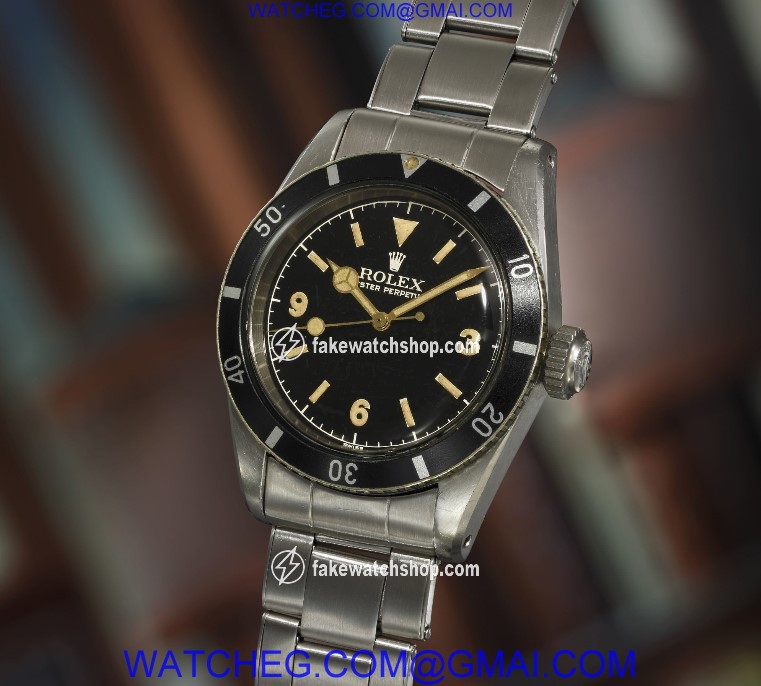 Rolex Submariner reference 6200. Image credit: PhillipsThe Sub gets an upgradeIn 1954, the Submariner received its first major upgrade with the release of reference 6200. This Submariner was the first reference to feature 200m of water resistance, doubling the rating of the Submariner references (6204 and 6205) that preceded it. The watch also featured the Explorer dial, and an oversized 8mm crown, making it extremely desirable today. Mercedes hands, which had made their way into the Submariner in the reference 6205 a year earlier, were also present. At this point, the Submariner retained its 37mm case diameter. The jump to 200m of water resistance, however, meant that even professional divers, not merely recreational divers, could rely on Rolexs most capable tool watch.
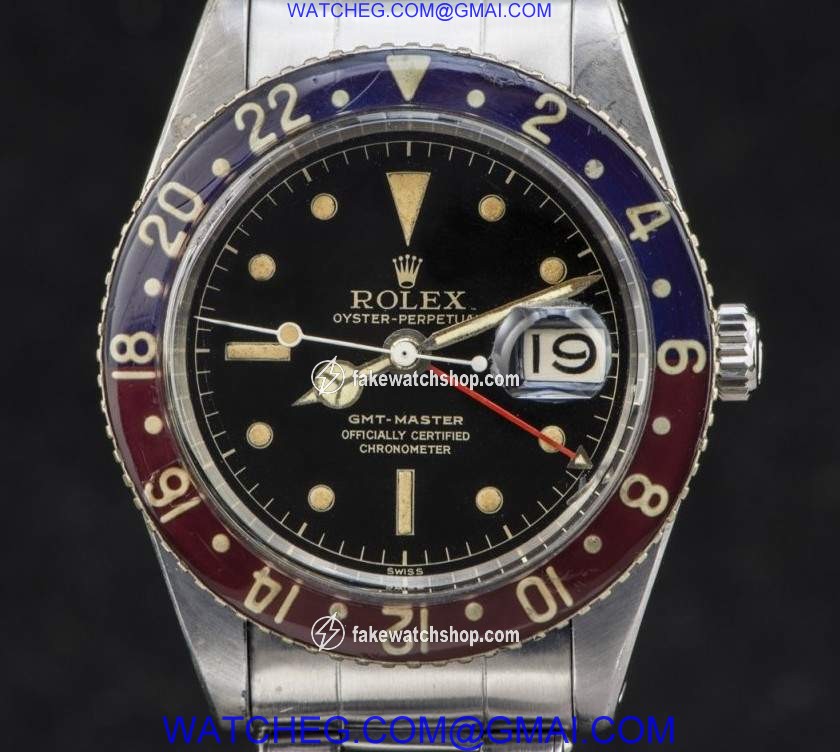 Rolex GMT-Master reference 6542. Image credit: John GoldbergerTaking to the skiesWhile some sources say 1954, Rolex specifies 1955 as the year that the first GMT-Master, reference 6542, came to market. Developed at the request of PAN-AM, one of the worlds leading airlines at the time, the GMT-Master was Rolexs first watch (though not the first in the world) to display two time zones. The GMT-Masters 50m water-resistant case was based on the Turn-o-Graph, but upsized to 38mm and equipped with a new, bidirectional, blue/red 24-hour bezel. The earliest bezels were made of bakelite, a type of resin that was, unfortunately, prone to breakage. These featured luminescent radium numerals. Rolex would replace these bakelite inserts with aluminum ones just a few years later.
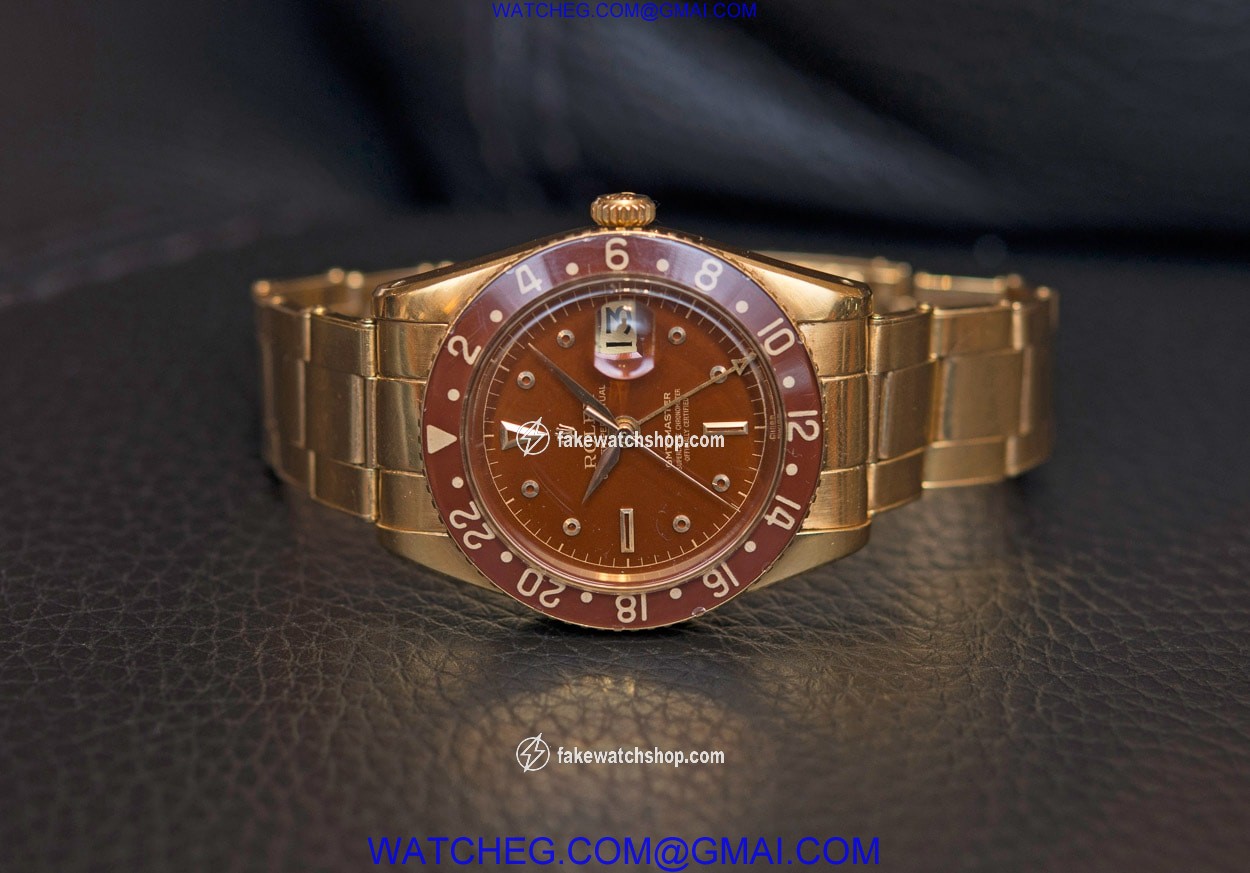 Rolex 6542 GMT-Master in goldThe first references were powered by the Rolex caliber 1030. Distinguishing itself from the Submariner, this caliber featured both a date indicator and a 24-hour hand. This hand was mechanically linked to the main hour hand, and not independently adjustable. To display a different time zone, the pilot would need to rotate the bezel. Like the Submariner, the GMT-Master would undergo a series of improvements and design modifications throughout the years. Rolex would produce reference 6542 until 1959. During that time, a full 18k yellow gold version with a brown dial and brown bezel even made its debut. While steel versions featured Mercedes hands and painted luminescent indices, gold versions featured alpha hands and applied gold indices. An Albino version of the 6542, in steel with a white dial, was even produced in very limited numbers for PAN-AM executives.
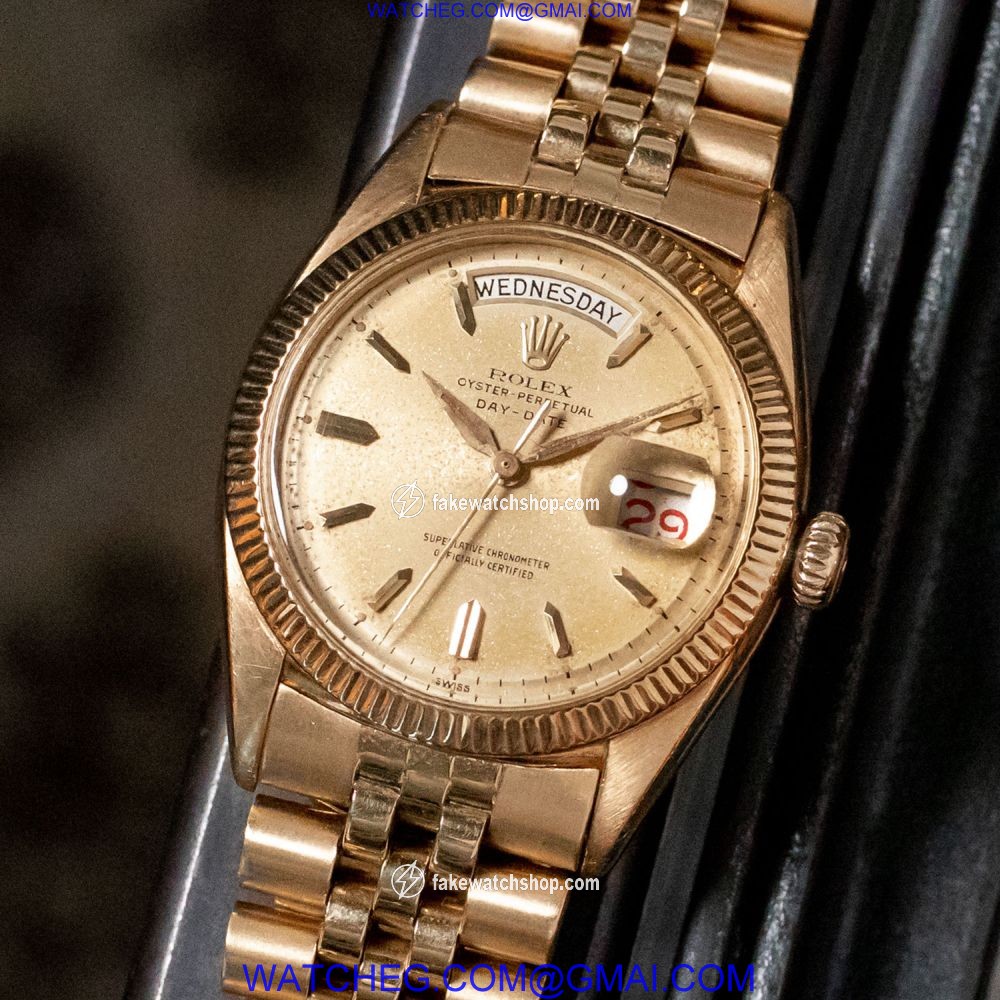 Rolex Day-Date reference 6511. Image credit: Amsterdamvintgewatches.comA watch for presidentsIn 1956, Rolex released the Day-Date. This now-legendary watch was the first in the world to show the day of the week spelled out in its entirety on the dial. Rolex released references 6510 with a domed bezel and 6511 with a fluted bezel concurrently. Though the watch was very much modeled after the Datejust, the Day-Date was produced strictly in precious metals. The Day-Date also featured a new, specially designed bracelet. Though it featured a three-link design, it was worlds apart from the Oyster bracelet and replaced the center links of the Jubilee with a single semicircular link. This bracelet was also the first to feature a new hidden clasp (featured in this article), giving it a seamless look. The earliest references featured the Rolex 1055 movement. Due to insufficient power reserve, however, the day disc often had issues changing over at midnight. Thus, Rolex produced these first two references for just three years.
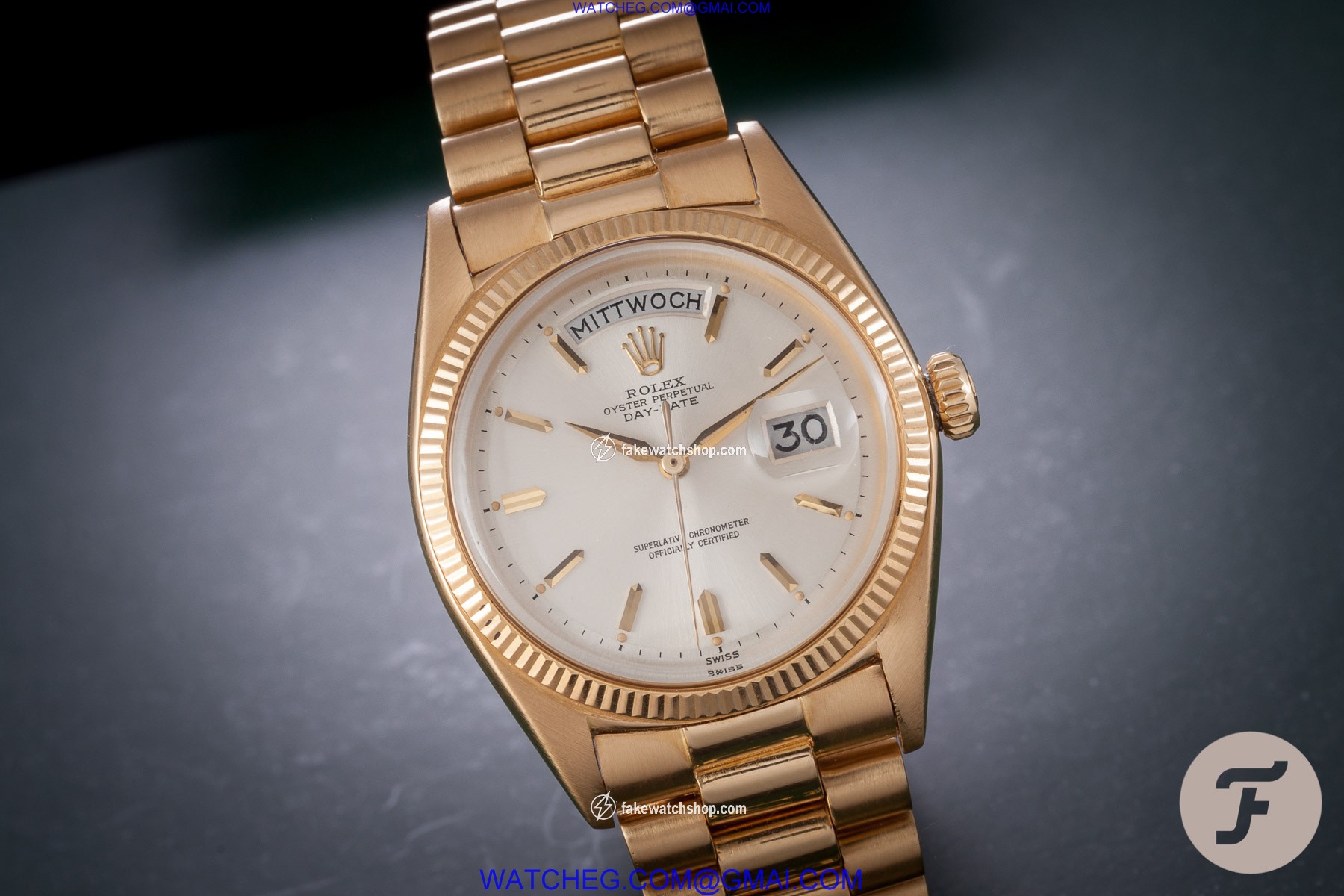 Rolex Day-Date reference 1803The brand released the Day-Date references 1802 (domed bezel) and 1803 (fluted bezel) in 1959. The watches featured a new, upgraded caliber 1555 that both corrected the day advancement problem and had a slightly higher beat rate. The Day-Date would go on to grace the wrists of several U.S. presidents, including Lyndon (Baines) Johnson, Richard Nixon, Gerald Ford, Ronald Reagan, and Donald Trump. This led Rolex itself to advertise the Day-Date as the presidents watch in the 1960s. The brand even officially dubbed the exclusive bracelet the President bracelet.
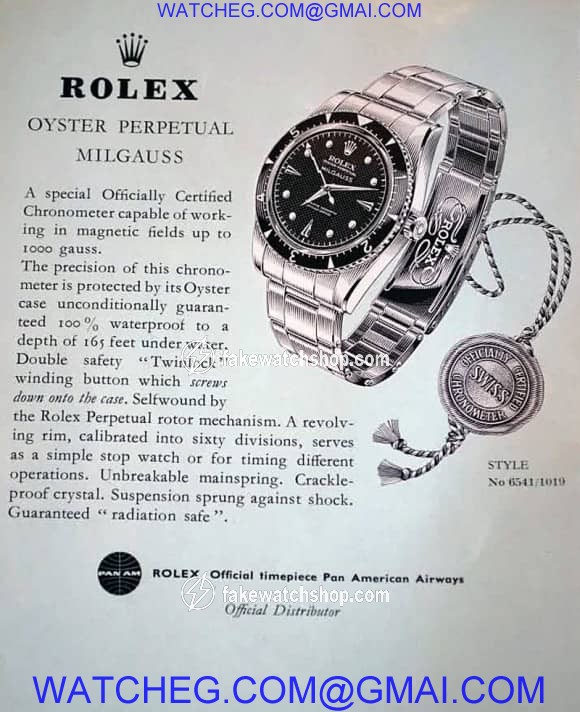 A watch for scientistsBacktracking slightly to 1956, the original year of release for the Day-Date, Rolex also introduced the Milgauss reference 6541. Developed for scientists who were constantly surrounded by magnetic fields, the Milgauss could stand up to the rigors of their working environment. By utilizing two ferromagnetic (highly magnetic) components (one attached to the case and the other to the movement itself), the Milgauss absorbed and diffused magnetism before it could enter the movement. Despite having no particular anti-magnetic properties itself, the caliber 1065 inside remained completely protected against magnetic fields up to 1,000 gauss. This was verified after rigorous testing by scientists at the European Organization for Nuclear Research (Conseil europen pour la recherche nuclaire, or CERN). At the time, the only watch as magnetic as the Milgauss was the IWC Ingenieur.
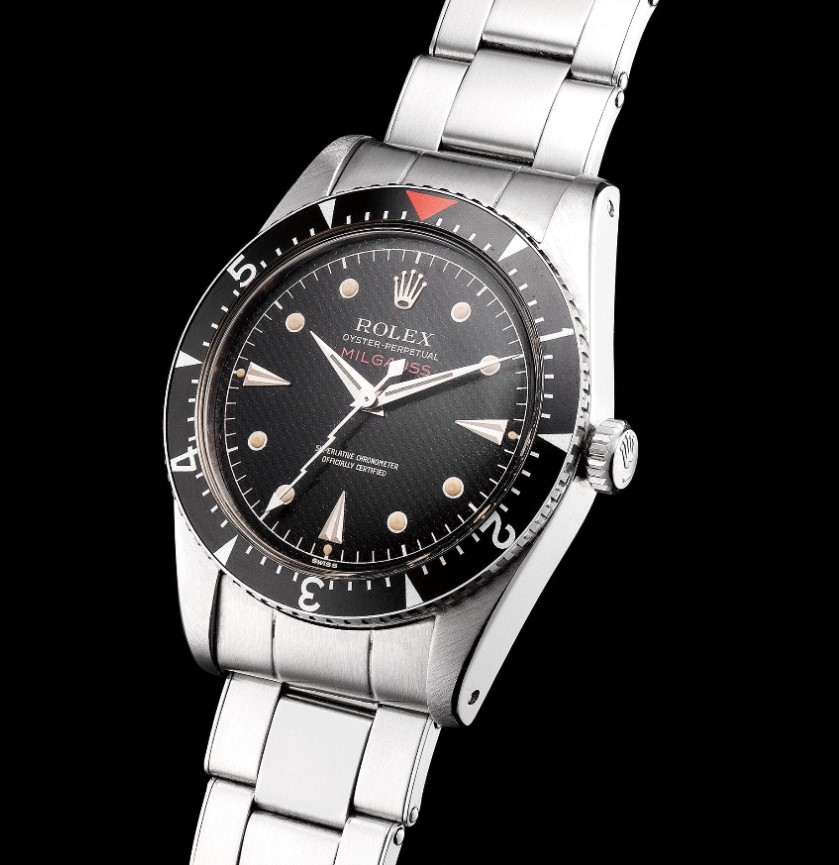 Rolex Milgauss reference 6541. Image credit: PhillipsThe Milgauss 6541 had a very unique design. The 50m water-resistant 38mm case featured a bidirectional 60-minute timing bezel, which, interestingly, represented ten-minute increments with single digits. The black dial had a honeycomb pattern, eight large luminescent indices, three smaller luminescent pips paired with beveled arrowhead indices, and an applied Rolex coronet at 12 oclock. The red Milgauss trademark contrasted the mostly white printing while perfectly matching the inverted triangle on the bezel. Luminescent dauphine hands provided a look distinct from the Submariner, while the Oyster bracelet gave it the same purpose-built aesthetic. Perhaps the most iconic design element, however, was the seconds hand. Shaped like a lightning bolt, this seconds hand would survive as basically the only stylistic link between the Milgauss 6541 and the Milgauss of today.
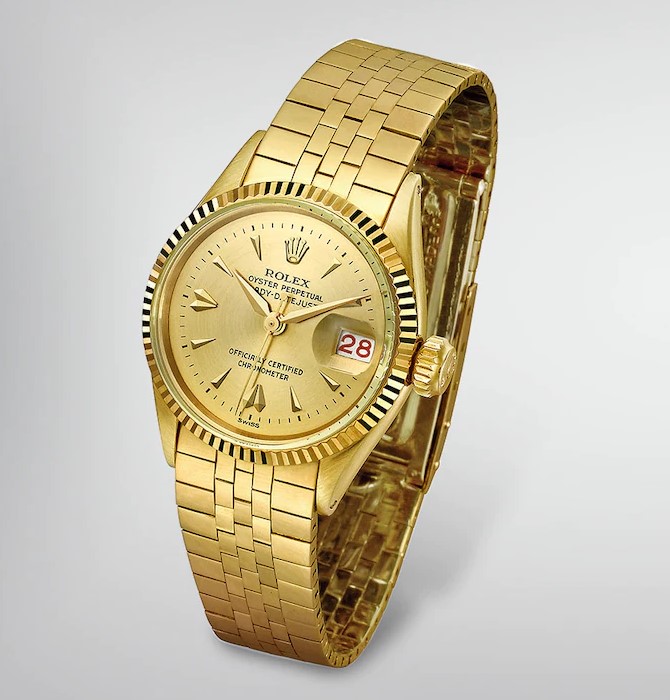 Rolex Lady-Datejust reference 6516The Datejust evolvesIn 1957, Rolex released its first movement with a rapid-change date, caliber 1500. For the first time, the date actually changed just at midnight, leading many today to believe that this was the inspiration for the model name. That is, in fact, incorrect, as the Datejust name clearly preceded this innovation. This technology, however, carried over into Rolexs future date-equipped calibers, including the 1555 caliber in the Day-Date that I mentioned previously. The same year, Rolex also released the Lady-Datejust for the very first time. 10mm smaller than the mens version at 26mm in diameter, the Lady-Datejust was available in nearly every metal, bezel, and bracelet combination one could imagine over a span of 65xx references.The next generation of the Submariner
 Rolex Submariner reference 5512 with square crown guards. Image credit: Revolutionwatch.comIn 1959, Rolex revised the Submariner once more. The update this time would lay the groundwork for the Submariner design of today. Like its predecessor, the new Submariner reference 5512 featured a glossy gilt dial and Mercedes hands. The case, however, was new, having grown 2mm in size to 40mm in diameter. The bezel itself was much more pronounced. Additionally, the crown was reduced from 8mm down to 7mm and, for the first time, shielded by crown guards. Aware that some divers had knocked the unguarded crowns of their Submariners, resulting in broken crown stems and compromised water resistance, Rolexs decision to add crown guards provided much-needed protection for the watchs most delicate exterior component. The shape of these crown guards evolved rapidly, from square to eagle beak shapes, then from pointed to rounded ones.
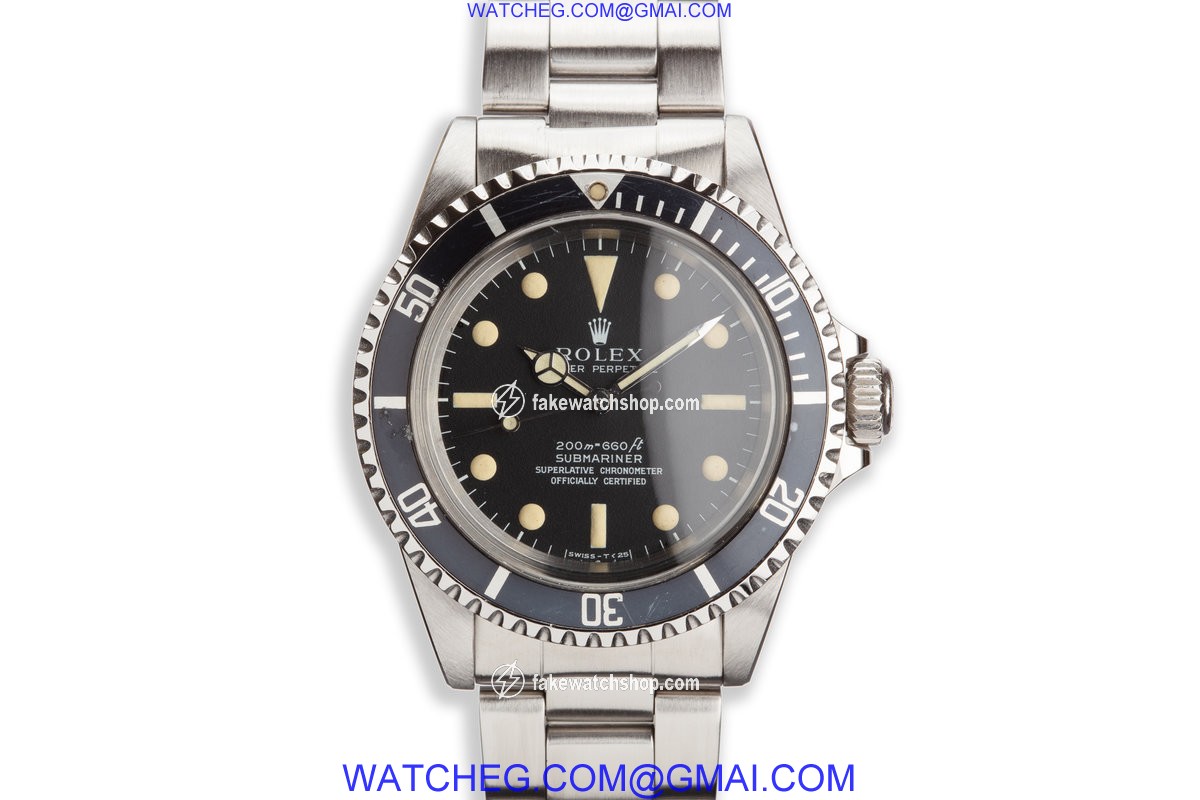 A later Rolex 5512 Submariner with meters first dial, chronometer certification, and rounded crown guards. Image credit: Hqmilton.comReference 5512 would remain in production until 1980. Along the way, Rolex made nearly countless slight adjustments to the design. These include, but are not limited to, both matte and glossy dials, chronometer and non-chronometer-certified calibers, two and four lines of text on the lower half of the dial, and feet first and meters first depth rating indications. These are the type of seemingly minuscule differences that many modern-day Rolex enthusiasts cherish so much.
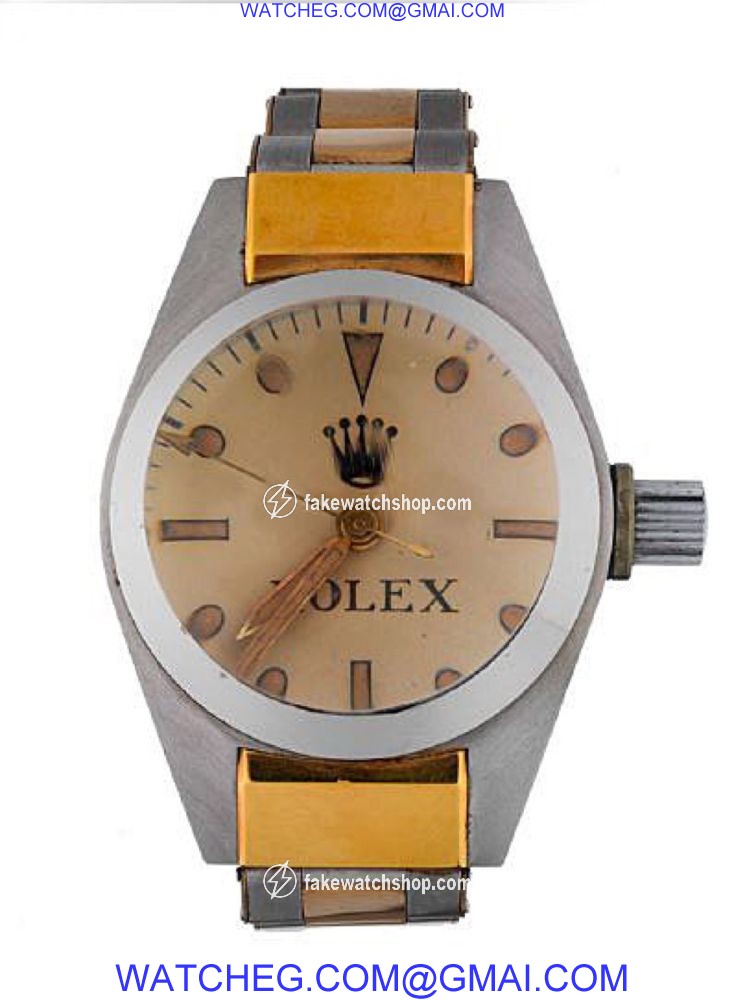 Rolex Deep Sea Special No. 3. Image credit: Rolexpassionreport.comRolex goes deeperIn 1960, a Rolex Deep Sea Special reached the deepest known part of the Pacific Ocean. On January 23, Jacques Piccard once again took to the murky deep in his bathyscaphe Trieste. This time, he was accompanied not by his father, but by United States Navy Lt. Don Walsh. The watch they took with them, known as Deep Sea Special No. 3, featured the same general case shape as the previous Deep Sea Specials, but a different, white dial and an even thicker domed crystal. This crystal was, reportedly, 33 times the thickness of a standard watch crystal.
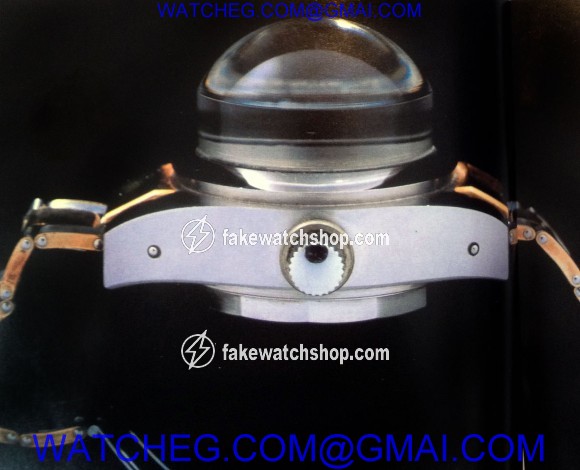 Image credit: Rolexpassionreport.comWith the watch attached to the outside of the Trieste, the pair descended to the deepest area of the Marianna Trench, known as Challenger Deep. The pair spent 20 minutes on the seafloor at an astonishing depth of 10,916 meters. This was over three times deeper than the first Deep Sea Special had traveled seven years earlier. After the pairs three-hour ascent to the surface, the Deep Sea Special was unfazed. The watch now resides in the Smithsonian Institution in Washington, D.C.